Overview
I am a member of the Applied Math research group. My research interests lie in the analysis and development of finite element methods with applications to problems such as
- Incompressible Navier-Stokes equations with variable density and viscosity
- Flows in highly heterogeneous porous media.
- Maxwell equations with variable permeability and conductivity.
- Nonlinear PDEs with nonlocal diffusive operator (Gray-Scott model)
- Turbulent flows, magnetohydrodynamics and oil reservoir simulations
My work also includes the development of open source software that can be applied the above problems (see bottom of the page for more information).
Research Projects - Overview
The following gives a short description of research projects I am working on.
Incompressible Multiphase flows
Outline.
The approximation of multiphase phase flows problems leads to solving the
Navier-Stokes equations where the fluid properties, such as density and viscosity,
are space and time dependent. To approximate such problems, my research focuses
on the development and analysis of numerical methods that are suitable for finite element and
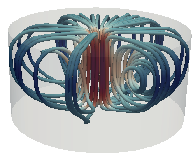
spectral methods. These methods are implemented in the code SFEMans and
they have been used to study magnetohydrodynamics instabilities
in liquid metal batteries and allumina production cells. Other applications involving
thermodynamics problems are also considered (e.g. liquid metals cooled nuclear reactors).
Graduate Students: An Vu, Salvatore Giordano.
Collaborators. Jean-Luc Guermond (Texas A&M University),
Wietze Herreman (Paris-Saclay University),
Gerrit Maik Horstmann (HZDR, Dresden),
Caroline Nore (Paris-Saclay University)
and Norbert Weber (HZDR Dresden).
PDEs with nonlocal diffusive operators.
Outline.
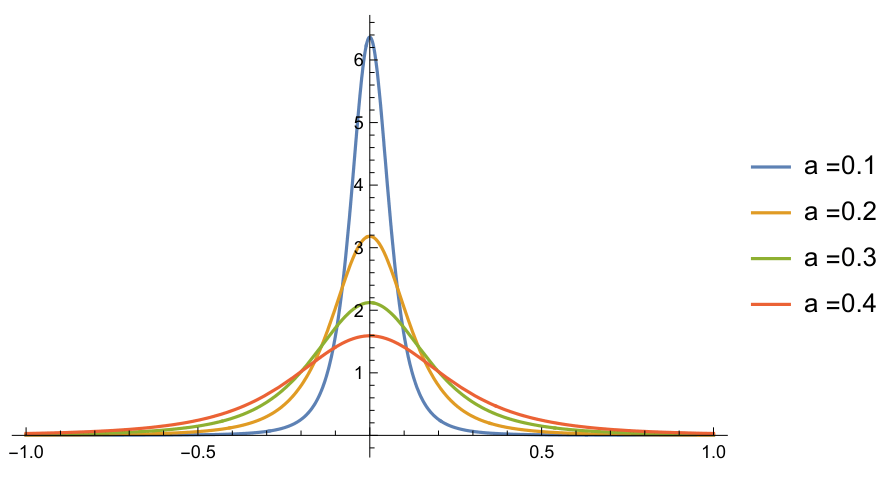
Nonlocal models can be used to study vegetation pattern, population dynamics, oscillating chemical reactions, or more generally problems that involve long-range interaction between particles or quantities of interest. Unlike local diffusive model, where diffusion can often be represented with a Laplace like operator, nonlocal diffusion are represented by integral operators leading to integro-differential equations that present many challenges. For instance, the solutions of such problems have weak regularity (i.e. L2 not H1) which bring more challenges when studing the existence and uniqueness of such solutions. From a numerical point of view, boundary constraints involve quantities defined in the complementary of the computational domain (so an unbounded domain), and the resulting stiffness matrices either involve full matrices or large stencils which limits the computational performance of numerical methods. Therefore, we aim to analyze and develop finite element and finite volume methods that can can approximate the above problems accurately and efficiently.
Collaborators. Gabriela Jaramillo (University of Houston),
Joshua Siktar (Texas A&M University),
Lander Besabe (Clemson University),
Cory Ward (previoulsy at the University of Houston).
Porous media: Black Oil model
Outline.
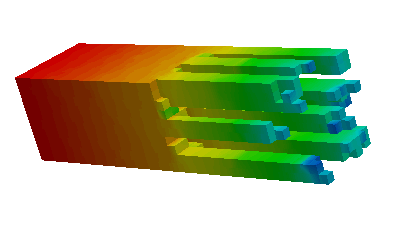
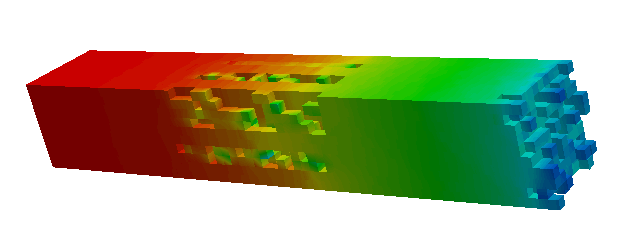
In the frame of reservoir simulation, I am interested in the approximation of black oil model
where a system is composed of three phase (liquid, vapor, aqueous) and three components
(oil, gas water) in a porous media (reservoir). To handle more easily unstructured mesh
and go toward high order element, we developed a discontinuous Galerkin finite element
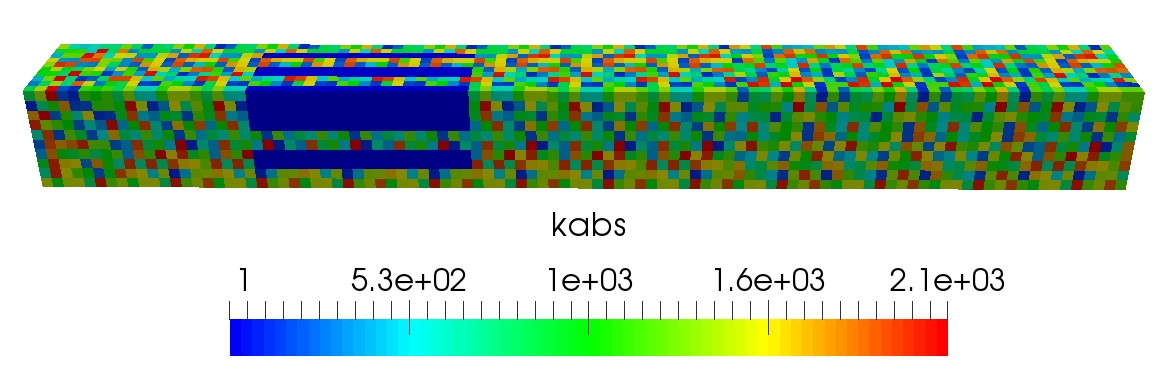
method that can deal with highly heterogeneous media and phase appearance/disapearance
without additional effort. The algorithm also allows mass transfer between the liquid and vapor phase
(meaning that the oil and gas can either be in liquid or phase phase).
The method is implemented in the code DUNE and allows us to study problem of oil extraction
and viscous fingers generation.
Graduate Students: Mark Simmons.
Collaborators. Beatrice Riviere (Rice University),
Vivette Girault (Paris VI University)
and Giselle Sosa Jones (Oakland University).
Turbulence and Large Eddy Simulation (LES) model
Outline.
The dynamo effect is the generation and/or the subtain of a magnetic field
from the convertion of the kinetic energy of a conducting fluid into magnetic
energy. This phenomena is important as it is responsible for the presence of
many magnetic field in geophysics (like the one of Earth). To get a better
understanding of the mechanism behing dynamo action, my research focuses
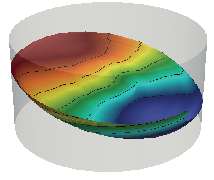
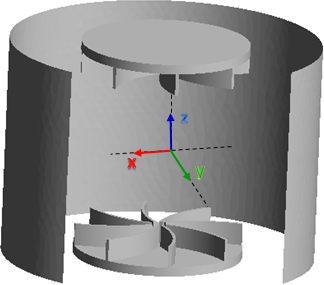
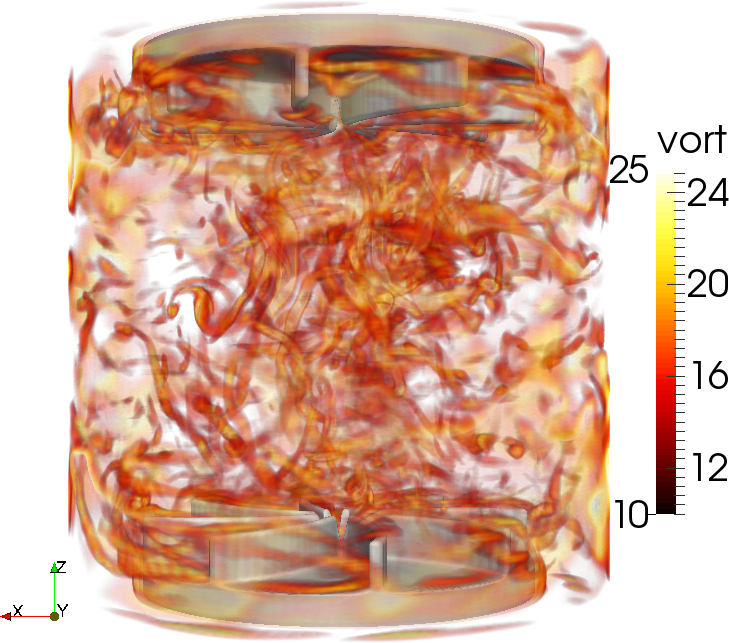
on the numerical study of two experimentals set ups of Von Karman flows (VKS, see right picture).
The two main numerical challenges are to be able to consider moving impellers that
drives the fluid into motion and that dynamo effect only occurs for large Reynolds number
where the flow become turbulent. We faced these difficulties by validating a large eddy simulation
(LES) model based on a entropy stabilization technique and by using a penalty technique to represent
the actions of the impellers.
Collaborators. Daniel Castanon Quiroz (Cote d'Azur University),
Jean-Luc Guermond (Texas A&M University),
Jacques Leorat (LUTH-Observatory of Paris),
and Caroline Nore (Paris-Saclay University).
Software Development
- SFEMaNS
- Fully parallel 3D solver in cylindrical coordinate for various problems in fluid mechanics involving magneto and thermal convection.
- Public GitHub
- Documentation
- HYPAR_SFE
- New Modern Fortran solver (in development) that aims to elliptic, hyperbolic and parabolic PDEs in 1D/2D/3D using finite elements (1D-2D) and pseudo-spectral element (3D cylindrical coordinates).
- Public GitHub
- deal.ii C++ module for Three Phase Flows in Porous Media